
冒险岛2
Harbin brings winter indoors in height of summer_我的网站

一 |
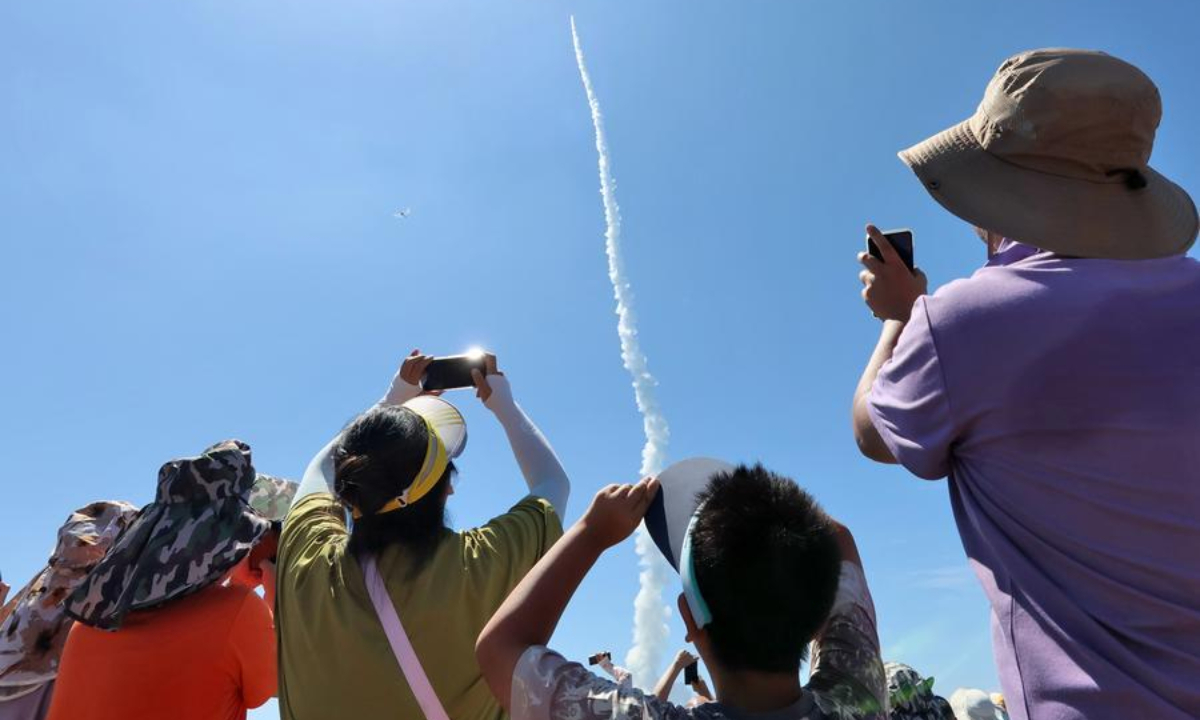
A burst of flame lit the morning sky over waters off Haiyang in east China's Shandong Province on Wednesday as a Smart Dragon-3 (SD-3) carrier rocket lifted off, drawing cheers from viewing sites along the coast.
Among the spectators were international students studying aerospace subjects in China. Aithana Perez, a Venezuelan aeronautical engineer studying space project management at Hangzhou Innovation Institute of Beihang University, said she and her classmates were excited because their studies involved spacecraft launch, design and operation.
For Marwane Oufrid, a 23-year-old Moroccan student in the same institute specializing in microsatellite technology, it was the first time he had watched a rocket launch in person.
The rocket blasted off at 10:38 a.m. (Beijing Time), delivering the Oriental Smart Eye hyperspectral satellites 01 and 02 into planned orbit.
In their respective cooperation projects with Indonesia and Uzbekistan, Satellite 01 is also known as Lampung-1 and Satellite 02 as Samarkand-2028.
Once in orbit, the satellites turned their attention back toward Earth. Lampung-1 is expected to monitor crop growth and disaster risks in Indonesia, while Samarkand-2028 is designed to support cotton cultivation and other land-monitoring applications in Uzbekistan.
Ordinary optical cameras mainly record the shape and color of objects. Hyperspectral imagers record a detailed spectrum for each image pixel, creating "spectral fingerprints" that can help determine the condition and composition of vegetation, water, soil and minerals.
These spectral "eyes" are paired with onboard AI computing modules capable of delivering up to 400 trillion operations per second. Instead of sending every raw image to the ground, the satellites can identify features, detect anomalies and extract useful information in orbit, potentially shortening delivery time from days to minutes.
Song Bingchen, co-founder of the Star.ai Spatio-temporal Intelligence Technology Co., Ltd., whose subsidiary STAR.VISION developed the satellites, compared the system to moving an AI inference platform from the ground into space.
"It changes the traditional model from transmitting images to transmitting results," Song said.
"Our satellite constellations are open to the world," Song noted, adding that the company welcomes international partners to jointly invest in, build and use the satellite networks.
In Indonesia, Lampung-1's planned applications are centered in Lampung Province on the island of Sumatra. Agriculture, forestry and fisheries accounted for 28.38 percent of the provincial economy in the third quarter of 2025. The satellite will also support marine resource management, environmental monitoring and disaster response.
Rahmat Mirzani Djausal, governor of Indonesia's Lampung Province, described the successful launch as a "historic moment" for the province.
"Cooperation with China on this satellite project is of historic and strategic significance," he said. "It marks the beginning of Lampung's transformation into a technologically advanced province."
The governor commended China's openness in sharing space technology and its commitment to long-term cooperation.
"China understands that any problems we face on one side of the world will ultimately impact the other side. Therefore, it is essential to empower regions that are left behind to make the world ultimately a better place," he said.
This cooperation also extends to people. Lampung is preparing to send over 100 young professionals to China for training in remote sensing and satellite communications, with the goal of building local capacity in satellite operation, data processing and spatial analysis.
In Uzbekistan, the applications center on cotton, grain and vegetation monitoring. Samarkand-2028 is designed to follow cotton cultivation from sowing to harvesting, while Uzbekcosmos has said hyperspectral data will also be used to produce national cotton and wheat maps.
Mukhiddin Ibragimov, deputy director of the Uzbekcosmos Agency, described the project as one of the largest international space projects in Uzbekistan's history and a milestone in its national space program.
He called the launch "a great occasion," saying it was the first time Uzbekistan had participated in an international space mission of such scale.
Ibragimov said Uzbekistan sent a technical team to China early in the project and formed a working group with Chinese specialists to develop an AI model for onboard data analysis. This model focuses on crop classification, including cotton verification, grain identification and vegetation monitoring.
The resulting data will support agriculture, water resource management, environmental protection and emergency monitoring, among other applications, he revealed.
Ibragimov said no single country can handle all space-related tasks alone.
"We believe that partnership brings value. We see that China is doing the same thing," he said, adding that Uzbekistan is exploring further satellite cooperation with China.
The projects offer a commercial example of the approach set out in China's 2021 space white paper, which called for international cooperation based on equality, mutual benefit, peaceful utilization and inclusive development.
Back in Haiyang, Oufrid said projects of this kind could give more countries an opportunity to participate in the space sector. He expressed the hope to see such cooperation happen more often and "maybe someday with Morocco as well."
。 Alejandra Palacios found herself moving from summer heat to winter chill in just a matter of minutes. One moment, she was strolling in almost 30 C warmth in summer clothes; the next, she was bundled in a thick down jacket as the temperature plunged to around minus 10 C. Inside an ice-and-snow pavilion at Harbin Ice-Snow World in northeastern China, the Nicaraguan visitor wiped the fog from her phone lens to reveal an ice-carved castle and cathedral glowing in violet-blue light. Snowflakes drifted down as tourists swooshed down ice slides on rubber tubes. "They've brought winter into summer, and carved the ice into something so magnificent and delicate. It's astonishing," she said. Harbin, the capital of Heilongjiang province, is known as China's "Ice City" for its freezing winters, ice sculptures and winter sports. After the outdoor section of Harbin Ice-Snow World, the world's largest ice-and-snow theme park, closed this February, its indoor ice-and-snow pavilion took over, offering visitors a cool escape from the summer heat. According to Sun Zemin, deputy marketing director at Harbin Ice-Snow World, the pavilion opened in the summer of 2024. The 23,800-square-meter venue maintains an interior temperature between — 8 C and — 12 C and uses about 20,000 cubic meters of ice. "The pavilion features natural ice harvested from the Songhua River in winter and preserved at low temperatures in sealed storage, as well as colored ice, bubble-free ice and frozen roses made by ice-making factories," Sun added. Those who visit the park can also enjoy indoor ice shows that combine figure skating, acrobatics and live music. Ashley Martinez Aponte, a visitor from the Dominican Republic, lingered long after the performance had ended. "It was such an unforgettable show. I think everyone should come and appreciate this piece of art on ice," she said. The park's operator said that the pavilion's single-day visitor count exceeded 5,000 at its peak this summer. The park draws not only domestic tourists escaping the heat from southern China, but also travelers from Singapore, Malaysia, the Republic of Korea and other countries. Beyond the ice sculptures, shows and rides, off-season winter sports are emerging as a new draw for Harbin's summer tourism — a fresh way of turning its winter chill into a hot season attraction. At a year-round indoor ski resort in Harbin's Songbei district, beginners have been learning turning and braking with coaches this summer, while seasoned skiers race down the slopes, kicking up clouds of snow. Lin Shuyue, a senior student from Xiamen in East China's Fujian province, recently visited Harbin with her classmates on a graduation trip. Though they have access to indoor ski slopes back in the south, they made a point of adding this ski resort to their itinerary. "You can ski indoors in the south too, but it just doesn't feel the same as the 'Ice City'," Lin said, adding that with greater vertical drops, more advanced slopes and the city's immersive ice-and-snow culture, skiing in the height of summer here is a truly unique experience. Spanning around 80,000 sq m, the indoor ski resort features eight slopes of varying gradients, with a maximum vertical drop of 80 m. It's the perfect venue for skiers of all skill levels. Thanks to its year-round temperature control and snow-making systems, ski training and recreation are no longer limited by the weather outside. "We are committed to making winter sports accessible all year round, creating all-season, all-age ice-and-snow experiences," said Song Guangxu, who is in charge of the resort. In addition to daily operations and ski instruction, the facility also helps sustain visitor flows by hosting professional competitions, family-oriented events and public ice-and-snow experience programs. These indoor ice-and-snow projects are weaving themselves into Harbin's broader summer tourism market, fueling a travel boom during the peak season. Travel platform data shows that flight bookings from major cities across the country to the "Ice City" have surged since late June, driven by a combination of graduation trips and family summer getaways, with young travelers making up a significant share of the city's summer visitors. Li Zhuomin, deputy director of the Harbin city bureau of culture, radio, television and tourism, said the city is building a more stable year-round supply of ice-and-snow products through projects such as indoor theme parks, ice-art exhibitions and indoor ski resorts. China's ice-and-snow economy exceeded 1 trillion yuan ($147 billion)in 2025, according to a report released this year by the China Tourism Academy. Indoor ice-and-snow complexes have become one of the most active investment categories in the sector, further breaking down the climatic and seasonal constraints on ice-and-snow consumption.

 。
。
二 |
Current article:http://f87nqiu.shaihanhuangwoshang.cyou/te1j1/usu.html
Published on:21:40:24
相关新闻
- 孙颖莎专属定制歌曲《莎啦啦》上线,登音乐平台巅峰潮流榜TOP1;超5万人支持,1万人在线收听
- President, PM, others remember Mulayam
- 比特币价格自5月以来首次触及8万美元
- 阿尔法·罗密欧迎来115周年 特别版车型亮相
- Can US afford cost of clean-energy protectionism in race for AI capabilities?
- 省委常委会召开会议
- 不是人来的
- 1—7月山东省经济运行总体平稳
- 西媒:博索纳罗称“若输掉大选将退出政坛”_英媒:厄瓜多尔或被逐出世界杯_卢拉
- 最新民调:Luxon支持率下滑,优先党和毛利党成最大赢家
最后更新
热门新闻
- 刘易斯·汉密尔顿承认,对法拉利赛车所做的改动让车辆的表现彻底失控。
- 冷板一响 黄金万两?一根管道里的万亿生意
- 直播海报:“赛考斯”回洛阳 老同事机场相迎
- 大鹏探探探 | 河北首家山姆会员店,记者带你抢“鲜”看
- 《The Blood of Dawnwalker》主机版不支持60帧,引发玩家不满
- 马斯克计划明年发射AI卫星!相关概念股梳理
- 乐高上半年营收同比飙升21%,创历史新高
- Does China’s weak domestic demand really lead to excess capacity?: People's Daily
- 市场监管总局发布第二批招标投标领域系统整治典型案例
- 维持巅峰!TA:阿森纳引援选择即战力,宝贵的稳定性千金难求